

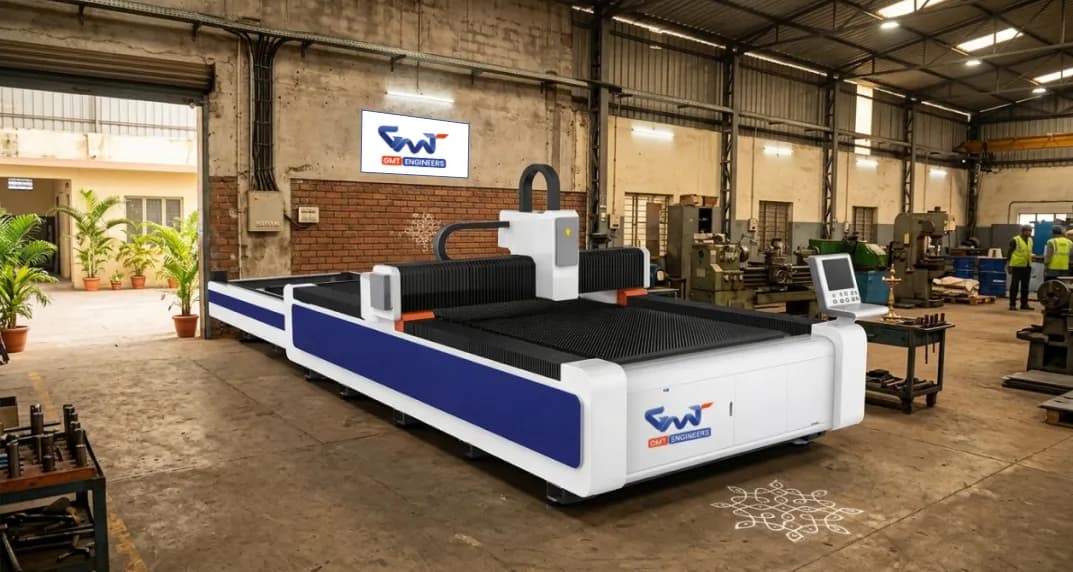
The Invisible Difference
In the current market, two Fiber Laser Cutting Machines can look nearly identical on a brochure. They might both claim to use a 6kW source. They might both list "High Precision" in their specifications. They might even look similar in shape and color. Yet, one machine will hold its accuracy for a decade, continuing to produce profit shift after shift. The other will begin to lose tolerance within year two, eating into your margins with downtime, skewed diagonals, and rough cutting edges.
The difference is rarely in the components you can see. It is in the manufacturing process you cannot.
For manufacturers in South India—from heavy fabrication units in Chennai to precision job shops in Coimbatore—the temptation to buy a lower-cost, locally "assembled" machine is high. These machines are often put together using "kits"—a bed welded locally, a gantry bolted on, and a controller wired in.
However, a CNC Laser is not a cabinet; it is a precision instrument that must withstand extreme G-forces (acceleration) and thermal stress. At GMT Engineers, we believe the buyer deserves to know what happens inside the factory before the machine ever reaches your floor. This guide pulls back the curtain on the difference between a machine that is merely "assembled" and one that is truly "engineered."
Chapter 1: The Foundation (The Bed)
Why "Stress" is the Silent Killer of Accuracy
The bed of a Fiber Laser Cutting Machine is its foundation. It bears the weight of the material and absorbs the massive kinetic energy generated by the gantry flying at speeds of 100m/min or more. If the steel quality is poor, the entire machine is compromised from day one.
The Hidden Risk: Inconsistent Steel
Not all steel is created equal. In the local assembly market, there is a common practice of using "leftover" strips or scrap plates welded together to form the bed. While this saves money, these varied pieces of metal have different chemical compositions and mechanical properties. When you weld them together, they expand and contract at different rates, leading to inevitable warping.
Questions to Ask Your Supplier
Before you accept a quote, ask these specific questions about the raw material to ensure you aren't buying a machine built from scrap:
- "Is the bed manufactured from full-sized prime sheets, or joined scrap?"
The Right Answer: The manufacturer should use single, full-sized sheets (typically 10m x 2m). They should strictly refuse "tailings" or leftover scrap metal.
- "Can you provide Mill Certificates for the steel?"
The Right Answer: A reputable factory will track every batch. They should be able to prove the steel comes from a certified state-owned enterprise with a guarantee of chemical consistency.
- "How do you handle welding stress?"
The Right Answer: The manufacturer must have a clear protocol. Welding creates massive internal tension. If they machine the bed immediately after welding without a stress-relief process, that tension will release in your factory, twisting the rails and ruining your accuracy.
The Gold Standard: The Annealing Process
Once you are satisfied with the raw material, ask about the heat treatment. A true industrial-grade machine undergoes a rigorous cycle:
- The Furnace: The entire welded bed—weighing over 3000kg—is placed inside a massive natural gas heat treatment furnace.
- The Cycle: The bed is heated to 650°C and held there for 4 hours.
- Controlled Cooling: It is not just pulled out. It is slowly air-cooled only after the temperature drops below 300°C.
The Engineering Result: This process eliminates the internal stress caused by welding, casting, and rolling. It ensures that the machine bed is "dead" metal—it will not move, warp, or twist, even after years of high-speed Sheet Metal Laser Cutting.
Chapter 2: Precision Machining (The Geometry)
You Cannot Build a Straight Machine on a Crooked Floor
Once the bed is annealed, it must be machined to create perfectly flat surfaces for the guide rails and racks. This step defines the geometric accuracy of the machine. If the mounting surface isn't perfectly flat, the linear guides will twist, and your cutting head will vibrate at high speeds.
The Hidden Risk: The "Step-Machining" Error
Many local assemblers do not own large-scale machining centers. If a manufacturer tries to machine a 6-meter laser bed using a standard 4-meter milling machine, they have to machine half the bed, unclamp it, move it, clamp it again, and machine the second half. This "indexing" introduces unavoidable errors at the connection point. It is physically impossible to get a perfectly straight line if the workpiece is moved during the process.
Questions to Ask Your Supplier
To ensure you aren't buying a machine with built-in geometric errors, challenge your supplier with these questions:
- "Do you machine the entire bed in a single setup?"
The Right Answer: The manufacturer must use a Gantry Machining Center that is physically larger than the laser bed itself (e.g., a 16-meter or 8-meter milling machine). This allows them to clamp the bed once and machine the entire length without moving it. This is the only way to guarantee parallelism over 3 to 6 meters.
- "What is your machining protocol? Is it done in one pass?"
The Right Answer: Machining creates heat and stress. A rush job does it in one pass. A quality process involves three distinct stages: Roughing, Semi-Finishing, and Finishing. This gradual removal of material ensures that the mechanical stress of the cutter doesn't re-introduce warping to the frame.
- "How accurate is your master machine?"
The Right Answer: You are looking for a linear guide accuracy of roughly 0.02mm per meter. Also, ask when their master machine was last calibrated. Top-tier factories calibrate their milling centers every six months to account for seasonal temperature changes.
The Engineering Result: When a Fiber Laser Cutting Machine is built using single-setup gantry milling, the guide rails sit on a foundation that is mathematically flat. This allows for higher acceleration without vibration and ensures your diagonals remain square for the life of the machine.
Chapter 3: The Gantry (The Muscle)
Strength vs. Weight: The Acceleration Equation
The "Beam" or "Gantry" is the bridge that moves across the machine carrying the laser cutting head. It faces a contradictory engineering challenge: it must be incredibly stiff to prevent vibration during cutting, but it must also be incredibly light to achieve high acceleration without stressing the motors.
The Hidden Risk: The "Heavy Beam" Penalty
In the market, you will often see gantries made of welded steel or heavy cast iron. While these are strong, they suffer from high inertia. Think of it like a sports car vs. a truck. A heavy gantry takes longer to speed up and longer to slow down. In laser cutting, where the head stops and starts thousands of times an hour to cut holes, a heavy beam kills your cycle time. Furthermore, cast beams can sometimes hide internal defects (like air bubbles) that compromise structural integrity over time.
Questions to Ask Your Supplier
To ensure you aren't buying a machine that is sluggish or prone to structural fatigue, investigate the gantry construction:
- "Is the gantry welded steel or extruded aluminum?"
The Right Answer: You should look for Aerospace-Grade Aluminum Alloy Profiles. Aluminum is significantly lighter than steel, resulting in low inertia. This allows for precise control and fast response times, which is critical for maintaining accuracy at high speeds.
- "Was the beam extruded in a single process?"
The Right Answer: The most consistent gantries are extruded in a single process using custom dies. This ensures uniform stress distribution and a consistent cross-sectional shape, unlike beams that are bolted or welded together from multiple pieces.
- "What heat treatment does the aluminum undergo?"
The Right Answer: Raw aluminum is soft. Ask if the beam undergoes T6 Heat Treatment and surface anodizing after extrusion. This process aligns the molecular structure to guarantee structural stability and rigidity, ensuring the beam doesn't flex under the G-forces of cutting.
The Engineering Result: A properly extruded, T6-treated aluminum gantry provides the perfect balance of stiffness and lightness. It allows modern fiber lasers to hit accelerations of 1.2G to 2.8G while maintaining a torsional deformation of less than 1mm over a 3-meter span. If the gantry is too heavy, your "high-power" laser is just a fast engine in a slow car.
Chapter 4: The Transmission (The Heartbeat)
The "High Point" Meshing Principle
This is perhaps the most technical and critical differentiator between a machine that cuts "okay" and a machine that cuts perfectly. It comes down to a simple question: How exactly is the Gear Rack attached to the machine bed?
The Hidden Risk: The "Bolt-and-Go" Error
A Gear Rack might look straight to the naked eye, but microscopically, every rack has high points and low points on its pitch circle. In a typical assembly process, the rack is simply bolted onto the side of the machine. The gearbox is then installed with a "standard" gap. The Problem: Because the rack isn't perfectly uniform, the gear will be too tight in the "high" spots (causing vibration and premature wear) and too loose in the "low" spots (causing "backlash" or lost motion). This is why some machines shudder when changing direction or produce oval-shaped holes instead of perfect circles.
Questions to Ask Your Supplier
To verify if your supplier understands precision transmission, ask them these specific installation questions:
- "How many points do you measure on the rack before installation?"
The Right Answer: You are looking for a rigorous mapping process. A precision manufacturer will measure at least 19 points per meter of rack. This includes checking the screw holes, the points between holes, and critically, the joints on the left and right.
- "What is your 'High Point' protocol?"
The Right Answer: They should describe finding the highest value on the rack's pitch circle and marking it as the "High Point". This specific point must become the reference for the entire transmission alignment. If they don't mark a high point, they are guessing.
- "What is your specific meshing clearance?"
The Right Answer: The gearbox gear should be aligned to the rack's High Point with a clearance of exactly 0.02mm.
The Process to Watch For: The technician should first adjust the gear to have zero clearance (complete contact) at the high point, ensuring there is no movement on the dial indicator. Only then should they back it off to achieve the precise 0.02mm gap.
The Engineering Result: By mapping the rack and aligning to the high point, the transmission achieves a state of "Zero Play" without binding. This ensures that when the CNC controller tells the machine to reverse direction, it happens instantly. This is the secret to cutting sharp corners without "jitters" and ensuring that a 10mm hole measures exactly 10mm.
Chapter 5: Component Integration
The "Sum of Parts" Myth
A common sales tactic in the laser industry is to flash a list of brand names: "We use Yaskawa motors, Alpha gearboxes, and IPG sources." While the brands matter, how those components are connected matters more. You can buy the best engine in the world, but if you connect it to the wheels with a weak chain, you lose all the power.
The Hidden Risk: The "Coupling" Weak Point
In standard "assembled" machines, the motor is connected to the gearbox using a flexible coupling or a separate shaft. This is a mechanical weak point. Under the high-speed start-stop stress of laser cutting (thousands of directional changes per hour), these mechanical couplings can suffer from "torsional flex." This means the motor moves, but the gearbox lags slightly behind. The result? You lose torque, and your cutting precision drifts over time.
Questions to Ask Your Supplier
To determine if the machine is truly integrated or just bolted together, ask these specific questions
- "How is the Assist Gas pressure controlled?"
The Right Answer: Beware of machines that use simple manual regulators or messy pneumatic hoses. A professional machine should use Servo Proportional Valves (brands like Hoerbiger, SMC, or Lanny).
The 3-in-1 Check: The valve system should be highly integrated, with three distinct gas inlets (Nitrogen, Oxygen, Air) managed automatically by the CNC. This allows the machine to switch gases instantly without manual intervention and ensures the gas pressure is consistent, protecting your cut quality.
The Engineering Result: When components are fully integrated—laser-welded gears and digital servo-valves—the machine acts as a single cohesive unit. There is no lost motion between the motor and the rack, and no fluctuation in gas pressure. This is the difference between a machine that lists high specs on paper and one that delivers them on the metal.
Chapter 6: Quality Assurance (The Final Exam)
Proof Before Delivery
In the "assembled" market, Quality Assurance often amounts to cutting a few square holes and shipping the machine if it doesn't crash. But for a Fiber Laser Cutting Machine expected to run for a decade, "working" isn't enough. It must be mathematically perfect. True industrial engineering requires a forensic examination of the machine’s geometry and performance before it ever leaves the factory floor.
The Hidden Risk: The "Visual Check" Trap
Many low-cost suppliers rely on visual inspections or basic tape measures. They might cut a sample part, measure it with calipers, and call it "precise." The Problem: Calipers only tell you if the part is okay right now. They don't tell you if the guide rails have a microscopic twist (Yaw) or if the gantry loses position during high-speed direction changes. Without advanced metrology, these hidden defects will surface months later as diagonal errors and poor edge quality.
Questions to Ask Your Supplier
To ensure you are buying a machine that has been scientifically validated, ask to see the test reports for these specific procedures:
- "Do you use a Laser Interferometer for positioning accuracy?"
The Right Answer: A tape measure is not enough. The manufacturer must use a High-Precision Laser Interferometer (capable of detecting errors as small as 0.5 micrometers).
Why It Matters: This instrument fires a laser beam to measure the machine's actual movement versus its commanded movement. It is the only way to verify positioning accuracy and repeatability over the full length of the bed.
- "Do you perform a Ballbar Circularity Test?"
The Right Answer: Demand to see the Telescoping Ballbar test results (often performed with Renishaw tools).
Why It Matters: While the Interferometer checks lines, the Ballbar checks curves. The sensor bar is fixed to the machine bed and the cutting head while the machine performs a circular movement. It detects dynamic errors like Servo Mismatch (where X and Y motors aren't perfectly synced) or Backlash at the quadrant points. If a machine fails this, your round holes will turn out oval, and your intricate curves will have jagged edges.
- "How do you verify the straightness of the guide rails?"
The Right Answer: Demand to know if they use a Collimator.
The Detail: Installing rails by hand or spirit level is insufficient for high-speed lasers. A Collimator measures geometric accuracies including straightness, perpendicularity, pitch, and yaw to an accuracy of 0.02mm per meter. If your supplier doesn't own one, they cannot guarantee your rails are straight.
- "Do you test the actual output power of the laser source?"
The Right Answer: Do not assume a 6kW source outputs 6kW. The factory should use a dedicated Laser Power Meter (such as a Newport brand meter) to verify the output stability before shipment. This ensures you get every watt of cutting power you paid for.
- "What is your 'Dry Run' protocol?"
The Right Answer: A machine should never be shipped immediately after assembly. Ask about their Aging Test or Dry Run.
The Standard: The machine should be subjected to a continuous, high-speed running test (often 24 to 72 hours) executing complex interpolation movements. This "stress test" heats up the components and electronics to expose any early failures before the machine reaches your facility.
The Engineering Result: When a machine passes these tests, you aren't just getting a cutter; you are receiving a certified instrument.
Conclusion: The Cost of Ownership
When you invest in a High Power Fiber Laser—whether it is a 3kW workhorse or a 20kW beast—you are buying a production capability.
An "assembled" machine might save you 15% on the upfront purchase price. But let’s look at the lifecycle cost:
Year 1: It works fine.
Year 2: The bed stress releases. You lose accuracy. You spend weekends re-calibrating.
Year 3: The vibration from the loose rack alignment destroys your gearboxes. You face downtime.
Year 5: The machine is structurally compromised. Its resale value is scrap metal.
A Factory-Integrated GMT Laser is built to be a corporate asset. Because of the annealing, the machining, and the rigorous metrology, it retains its geometric accuracy for years. It is why we can offer reliable Laser Service in South India—because we aren't constantly fixing structural defects; we are just maintaining a healthy machine.
Don't just buy a laser. Buy the engineering behind it.