

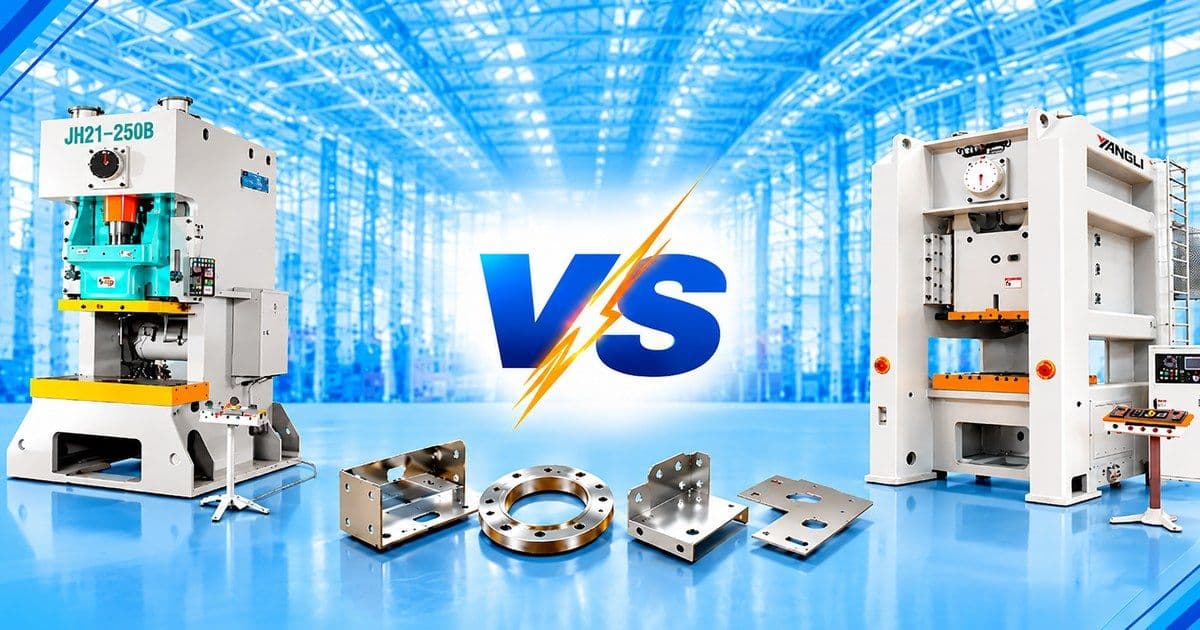
The C-frame vs H-frame power press decision shapes part accuracy, die life, operator access, productivity, and total machine cost. A C-frame press is open and versatile, suited to general-purpose stamping. An H-frame press is closed and rigid, built for higher precision, heavier loads, and demanding production.
Choosing the wrong Frame can lead to uneven die wear, inconsistent parts, or paying for capacity you do not need. This guide is written for manufacturers and buyers comparing power presses.
It compares the two on rigidity, accuracy, die life, tonnage, and cost shows which suits blanking, forming, progressive dies, and precision components, and explains running costs and maintenance. It also includes a buyer’s checklist, a list of common mistakes, and answers to common questions.
1. C-Frame Power Press: Design and Uses
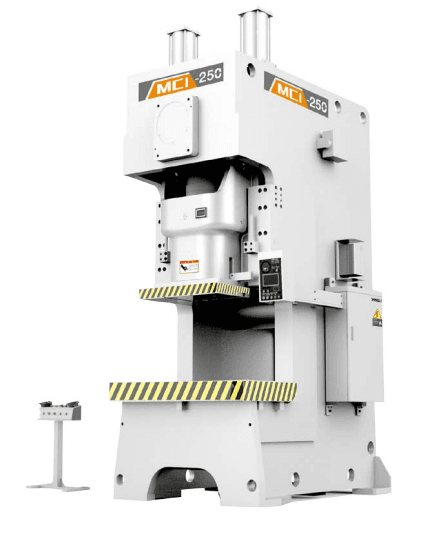
A C-frame power press has a frame shaped like the letter C, open at the front and sides. This generally gives operators easier access to the die area, which can simplify loading, Part removal, and die changes. A motor drives the ram up and down, carrying the punch into the die, which is part of the press tool used to cut or form the sheet. C-frame presses handle operations such as blanking, piercing, bending, and forming, depending on the die and tonnage.
They are often used for small and medium parts and simpler dies. Their main advantages are easier access, a generally lower purchase price than an H-frame of similar capacity, and a more compact layout. Being open, the frame deflects slightly under load, which may matter for work with tight tolerances. For such jobs, compare an H-frame press, covered next.
Another Key advantage of C-frame presses is how easily they integrate with automation. They pair seamlessly with 3-in-1 NC uncoiled-straightener-feeder lines, while deep –throat models can be coupled with XY tables as a cost effective alternative to turret punch presses. In addition, the compact spacing of a C-frame press line enables economical pick-and-place automation for high efficiency production.
2. H-Frame Power Press: Design and Uses
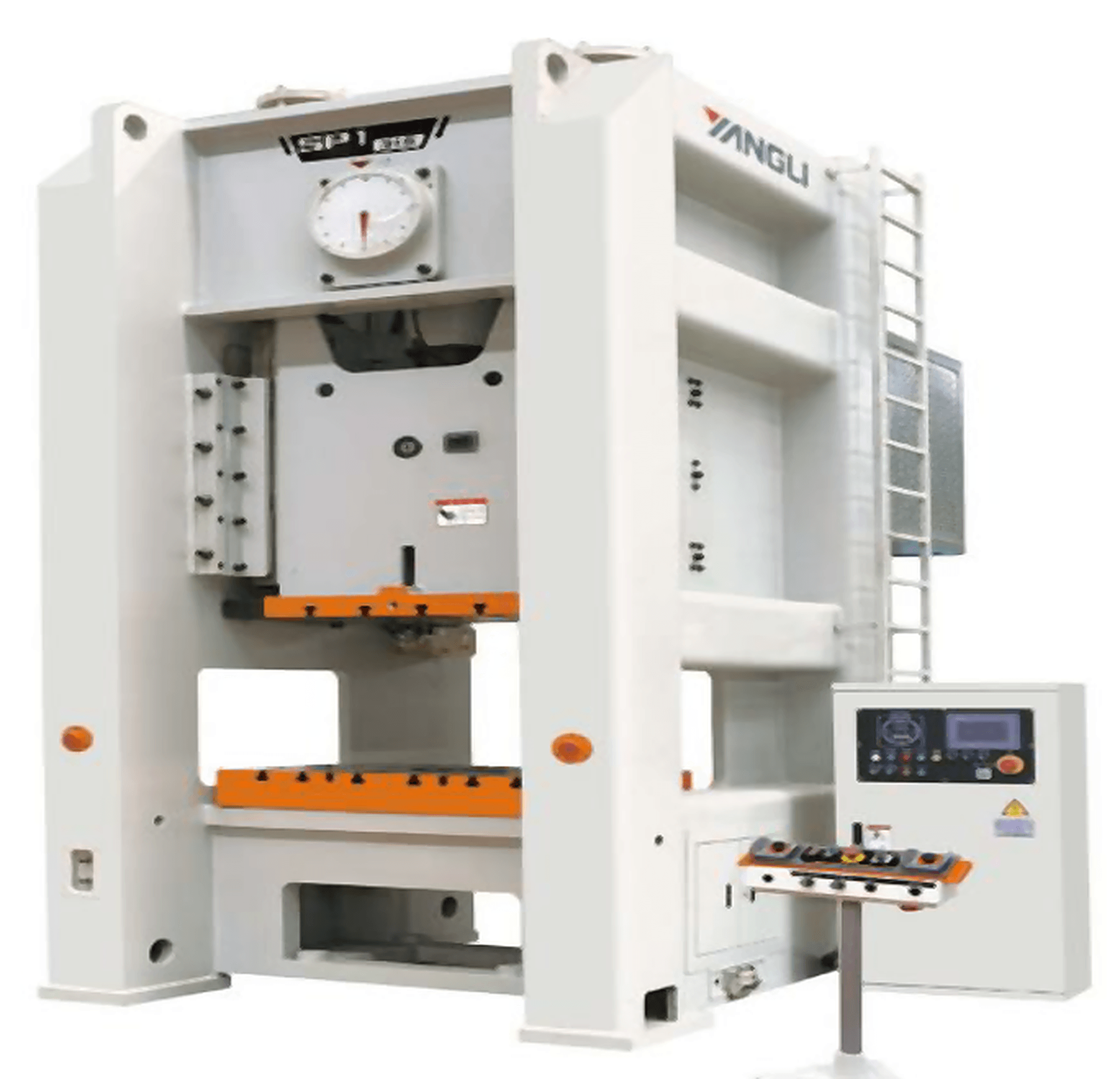
An H-frame power press has a closed frame, also called a pillar-type frame or straight-sided frame, the ram runs between two side members or pillars, so the force of each stroke is shared between both sides instead of passing through the single back section of a C-frame. This symmetrical design helps keep the ram and bed aligned under load. H-frame presses are commonly used for heavier blanking and forming, deeper drawing, progressive dies, and precision components.
Their main advantages are generally higher rigidity and better alignment, which supports part accuracy and can help reduce die wear caused by misalignment. The trade-offs are a generally higher purchase price, a machine that is typically larger and heavier and needs more floor space and a suitable foundation, and less open access, since parts and dies are mainly loaded from the front or back.
3. C-Frame vs. H-Frame: Key Differences
The line that introduces the table: The C-frame vs. H-frame comparison comes down to seven key points: access, rigidity, accuracy, die life, capacity, cost, and space.
C-Frame vs. H-Frame Power Press Comparison. This is a caption for the table, so a short descriptive name is enough.
4. Accuracy, Rigidity and Die Life: Which Frame Holds Up Better?
Every press frame flexes slightly under load, and its movement affects how well the punch and die stay aligned in a press tool. An H-frame generally holds alignment more steadily than a C-frame. In a C-frame, the open throat can allow more deflection than an H-frame. For a simple blank, this often has little effect. For a precision part, it can shift punch-to-die alignment. When the punch and die do not meet evenly, parts can show size variation or burr, and the punch and die in a press tool can wear unevenly.
The extra rigidity of an H-frame is worth considering when:
• Parts need tight tolerances
• You run progressive dies
• Production is high-volume or continuous
• Dies are costly and uneven wear is a concern
For simpler parts and lighter work, a C-frame is often a practical, lower-cost choice. The right choice depends on your component, die, and tonnage. If tolerance is critical, ask for the expected deflection at your working load.
5. Tonnage and Capacity: Choosing the Right Frame for Your Load
Start with the force required by your die and material, then add a safety margin to avoid running the press at its limit. Continuous operation near capacity can shorten machine life and affect part quality. C-frame presses are often used for light to medium-tonnage applications, while H-frame presses often handle heavier work. Exact capacity depends on the model, so confirm the rated figure before purchasing. Tonnage alone does not determine frame choice; die dimensions and accuracy requirements matter.
Check these specifications on each model:
- Rated tonnage and where it applies in the stroke
- Bed size and shut height for your largest die
- Stroke length and adjustment range
- Floor space and foundation requirements, especially for H-frame presses.
6. Matching the Frame to Your Component
- Simple blanking or piercing: C-frame. Easy access and lower cost, and alignment demands are modest.
- Forming and bending: either, depending on load and part. A C-frame suits lighter work, while an H-frame suits jobs where the force or part size grows.
- Progressive dies: H-frame preferred. Multi-station dies are more sensitive to alignment.
- Precision components: H-frame. Tight tolerances benefit from a more rigid frame.
- High-volume runs: H-frame in most cases. Consistent alignment supports repeatable output over long shifts.
Operator access, loading, and die changes
- Manual loading: C-frames provide open-side access for easier loading and unloading.
- Feeders and automation: C-frames allow front or side feeding, while H-frames generally require planned front or rear access.
- Frequent die changes: C-frames offer easier access, while H-frames may require lifting equipment or die-handling carts.
- Infrequent die changes: when dies run for long periods, rigidity usually matters more than access, then H-frame presses are preferred.
7. Running Costs and Maintenance
The running costs of C-frame and H-frame power presses depend on drive type, operating hours, production load, tooling condition, and maintenance practices.
Power consumption. Power use varies with motor rating and duty cycle. Mechanical presses use a flywheel, clutch, and brake; hydraulic presses use pumps and valves. Ask the supplier for expected consumption for your job.
Die and tooling wear. Good ram-to-bed alignment helps punch and die meet evenly, reducing uneven wear.
Routine maintenance. Lubricate, clean, tighten bolts, and check guards and alignment. Check the foundation on an H-frame and the throat of a C-frame for cracks or damage.
Wear parts and servicing. Clutch and brake parts, bushes, gibs, seals, and hoses wear over time. Operators can handle routine checks; technicians should handle repairs and alignment.
The cost trade-off. An H-frame usually costs more to buy, but steadier alignment may pay back in die life.
8. How to Choose: Buyer’s Checklist
Buyer’s checklist: Answer these questions before you request a quote
- Part size: What is the largest part and die set you will run?
- Tolerance: How tight is the dimensional tolerance, and does it depend on press alignment?
- Volume: How many parts per shift, and for how many years?
- Tonnage: What force does the process need, including a safety margin?
- Die changes: How often do dies change, and how are they handled?
- Budget: What is the purchase budget, and what do scrap and downtime cost you?
- Floor space: What space, foundation, and handling access do you have?
- Service: How quickly can you get spares, support, and operator training
9. Common Mistakes When Choosing a Power Press
- Choosing on price alone. A lower price does not help if the press cannot hold your tolerance. Compare the cost of scrap and die repair with the price difference.
- Buying more tonnage than needed. Extra capacity adds cost and space. Work out the real force, add a margin, and choose from there.
- Ignoring access. A rigid press that is awkward to load slows the line. Check how parts and dies will move in and out.
- Skipping the die set check. A press that does not fit your die cannot run your job. Confirm bed size, shut height, and stroke before you order.
- Leaving service for later. Spares and support affect uptime. Ask about them before you buy, not after.
- Mechanical or Hydraulic. Ask your tool and die maker the type of press required
10. Why Choose GMT Engineers for Your Power Press
GMT Engineers has supplied sheet metal machinery since 1988, backed by an experienced team who serve us over many years. We offer both C-frame power presses and H-frame power presses among many types, so you can compare the two against your own component instead of choosing from a single option.
You can see the machines in person at our Red Hills, Chennai warehouse, tell us which ones you would like to see and we will arrange your visit. Our team also provides installation, commissioning, and operator training. For spare parts and after-sales service, you can raise a request on our service request page.
GMT Engineers and Yangli: Our partnership
Our portfolio is built on long-standing partnerships with global industry leaders. We have worked closely with the Yangli Group, which was introduced to the Indian market through GMT Engineers, building a partnership based on trust and technical transparency.
Through this partnership, GMT supplies the Yangli mechanical range in India, including the MC series open-front C-type presses, the MG series gantry H-type presses and a whole variety of presses to suit any pressing job.
Get in Touch
Have a question about your press requirement? Contact the GMT team.
Call: 9444678000 | Email: webenq@gmtengineers.com