

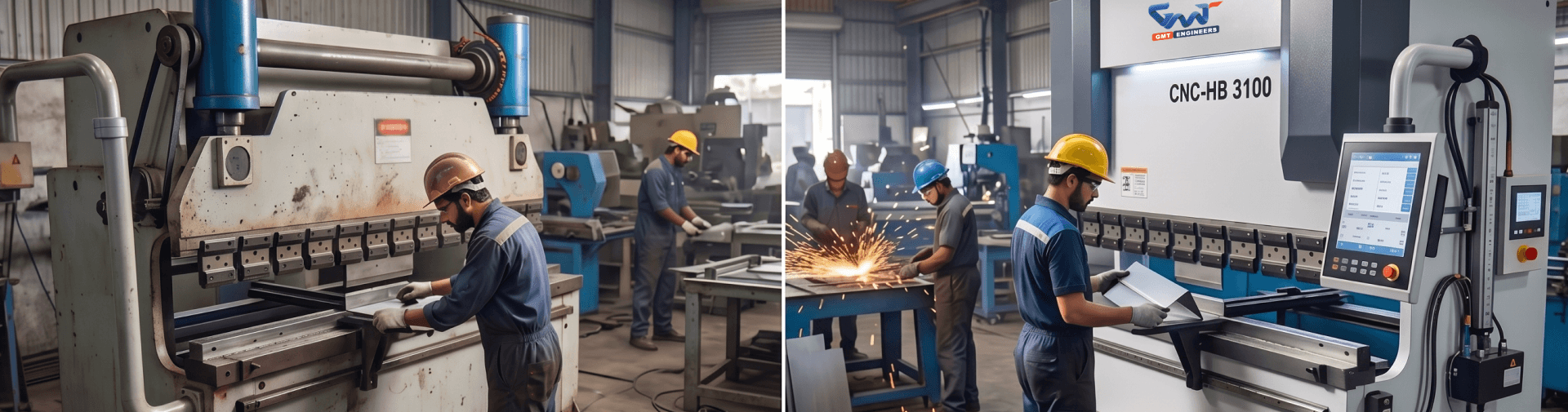
When upgrading your fabrication shop’s bending capabilities, making the leap from a manual or NC (Numerical Control) machine to a fully automated CNC press brake is a major milestone. It promises higher tonnage accuracy, precise angle consistency, and better high-volume throughput.
However, a highly deceptive trend is currently costing manufacturers—especially MSMEs—lakhs of rupees. Sellers are taking standard Torsion Bar NC machines, retrofitting them with a few modern components, and passing them off as "True CNCs."
If you are about to pay an advance on a new CNC press brake, pause and check under the hood. Here is how to ensure you are getting the genuine technology you are paying for.
The Anatomy of the Illusion
The deception is remarkably simple but visually convincing. Unscrupulous suppliers will take a standard Torsion Bar NC press brake and give it a cosmetic overhaul:
The Big Screen: They install a massive, glossy touchscreen interface that looks identical to high-end CNC controllers.
The Servo Motors: They mount two servo motors to control the Y-axis (ram depth) and X-axis (backgauge).
To the untrained eye, it looks, feels, and operates like a CNC. But beneath the slick interface lies outdated mechanical technology that lacks the one thing a true CNC requires: a closed-loop feedback system.
The Hidden Danger: Flying Blind
Why does this matter? Consider what happens during a standard high-volume production run.
In these modified "fake CNC" machines, the controller sends a signal to the servo motor to move the ram. But because it relies on a mechanical torsion bar to keep the ram level, the machine cannot verify if the ram actually reached the precise target.
If a servo motor belt snaps or wears down, the fake CNC doesn't know. It continues to force the bend blindly. The result?
Catastrophic mis-bends that waste expensive sheet metal.
Severe, uneven stress on the machine frame.
Premature wear or total destruction of your precision dies.
The True CNC Standard: Electro-Hydraulic Synchronization
A genuine CNC press brake does not rely on a mechanical torsion bar to keep the ram parallel. Instead, it uses Electro-Hydraulic Synchronization.
This system relies on precision Linear Scales (optical or magnetic encoders) mounted independently on the C-frames on both sides of the machine. These scales monitor the exact position of the ram in real-time (down to the micron) and feed that data back to the CNC controller.
If a component fails, a belt snaps, or the ram goes even slightly out of parallel, the linear scales detect the discrepancy instantly. Within 0.01 seconds, the closed-loop system triggers an alarm and stops the machine, saving your job, your tooling, and your machine frame.
Technical Comparison: NC Torsion Bar vs. True CNC
Use this quick reference guide to verify the specifications of your next machine quote.
Don't Buy the Sticker. Buy the System.
When scaling up your manufacturing operations, you need machinery that delivers uncompromised accuracy and long die life. A large screen and a "CNC" sticker will not save a bad batch of parts. Always inspect the mechanical anatomy of the machine, ask explicitly about linear scales, and demand electro-hydraulic synchronization.
At GMT Engineers Pvt. Ltd., we believe in engineering integrity. We supply true CNC bending technology designed to keep your production lines running flawlessly.