

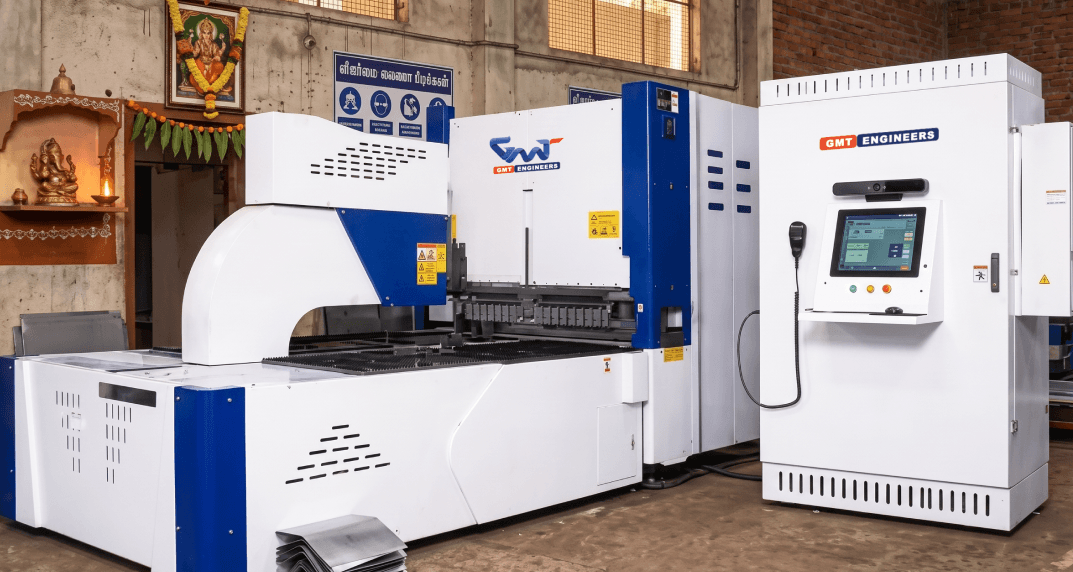
The landscape of sheet metal manufacturing in South India is undergoing a fundamental shift. For decades, the press brake has been the undisputed workhorse of shop floors from Peenya to Perungudi. However, as manufacturers in our region face increasing pressure regarding production velocity, skilled labor shortages, and the demand for export-quality precision, the limitations of manual bending are becoming apparent.
Enter the Panel Bender. Often misunderstood as merely a "faster press brake," the panel bender represents a completely different methodological approach to forming sheet metal. It is an upgrade in process philosophy—moving from operator-dependent craft to automated industrial strategy.
As the pioneers introducing this technology to the South Indian market, GMT Engineers provides this comprehensive guide. It is designed for production heads and business owners in Chennai, Coimbatore, Bangalore, Hyderabad, and Kochi who need to evaluate whether their production lines are ready to evolve from manual bending to automated folding.
What is a Panel Bender? (And How GMT Engineers Redefines It)
A panel bender is an automated CNC machine tool designed specifically for folding sheet metal. Unlike a press brake, where an operator manually holds the sheet against a backgauge, a panel bender keeps the sheet flat and stationary.
The sheet is manipulated automatically by the machine, while a pair of oscillating blades (one upper and one lower) fold the flanges.
The GMT Advantage:
While generic panel benders exist globally, the machines GMT Engineers brings to the Indian market are configured for the specific versatility needed here. Our machines go beyond simple 90-degree bends. They are engineered to perform:
- Hemming: Creating safe edges (open, closed, or teardrop hems) automatically without a secondary setup.
- Positive & Negative Bends: Folding up and down in a single cycle without flipping the sheet.
- Radius Bending: Creating smooth curves through step-bending.
This capability is what sets our offering apart: we don't just sell a machine that bends fast; we sell a machine that finishes the part completely.
The Pioneer’s Role: Why GMT Brings This to South India Now
Sheet metal automation is relatively new to our market. In all of India, there are currently only a handful of these machines in operation.
GMT Engineers is proud to be the exclusive partner bringing this specific class of panel bending technology to South India.
Why now? Because our hubs—Coimbatore’s Electrical control panel manufacturers, Chennai’s automotive ancillaries, Bangalore’s precision electronic enclosure makers—have hit a "volume ceiling." You cannot scale production purely by adding more manual labor anymore; the skilled manpower simply isn't available.
By introducing this technology, we are giving South Indian manufacturers a "First Mover Advantage"—the ability to bid for high-volume export contracts that require speeds manual press brakes cannot touch.
Panel Bender vs. Press Brake: A Critical Comparison
For decision-makers, the challenge is determining when to deploy a press brake versus a GMT Panel Bender.
The press brake is the "King of Versatility," ideal for thick plates and deep boxes. The panel bender is the "King of Productivity."
Comparison Table: Press Brake vs. GMT Panel Bender
The Business Case: Who Needs a Panel Bender?
Investing in a panel bender is a strategic decision. Based on our audits of shop floors across Hyderabad, Kochi, Bangalore and Tamil Nadu, we have identified the specific profile that achieves maximum ROI.
You are the right candidate for a GMT Panel Bender if your production fits this "Three-Point Profile":
- The "Twin Machine" Scenario (Volume)
You are currently running multiple press brakes dedicated to producing the exact same component because a single machine cannot keep up. If you need a second machine just to handle the volume of a repetitive part, you have outgrown manual bending.
- The "Under 3mm" Rule (Material)
The majority (80%+) of your production volume is in materials (MS, SS, or Aluminum) with a thickness of 3mm or less. This is the "sweet spot" where our panel benders outperform press brakes by a massive margin.
- The Labor Bottleneck (Manpower)
You face challenges in recruiting skilled operators in your region. Whether you are in the industrial belts of Oragadam or the fabricating electrical panels for the textile mills in Tirupur, the story is the same: the operators are retiring. GMT’s technology eliminates this dependency. The machine holds the skill, not the operator.
Key Benefits of Adopting GMT’s Technology
Unrivaled Production Velocity
On parts with 6-12 bends per side (like electrical panels or shelves), our panel bender achieves output rates conservatively 300% higher than a manual press brake.
Zero-Scratch Aesthetics
Because the sheet remains flat and isn't dragged across a V-die, our machines eliminate "die marks." This is critical for Bangalore’s electronics sector and Coimbatore’s appliance industries, where the visual finish of Stainless Steel is paramount.
Integrated Hemming
On a press brake, hemming is a slow, dangerous, two-step process. On a GMT Panel Bender, it is part of the automatic program. You get safe, reinforced edges without slowing down the line.
Service & Support: The GMT Footprint
One of the biggest hesitations in adopting new technology is support. “If this machine stops, who fixes it?”
This is why buying from a company with a 40 year legacy matters. GMT Engineers is not a faceless importer. We have a direct presence in Chennai, Bangalore, Hyderabad, Coimbatore, and Kochi.
When you install a GMT Panel Bender, you aren't just getting a machine; you are getting the full backing of our regional service network. We stock the spares, we train your operators, and we ensure the machine runs at the uptime your business demands.
Conclusion
The panel bender is more than just another machine; it is a declaration of intent. It signals that your manufacturing unit is ready to graduate to "industrial scale."
While the press brake remains an essential tool for versatility, the future of high-volume manufacturing in South India belongs to automation.
Contact our technical team in Chennai, Bangalore, or Coimbatore today to schedule a study of your components.