

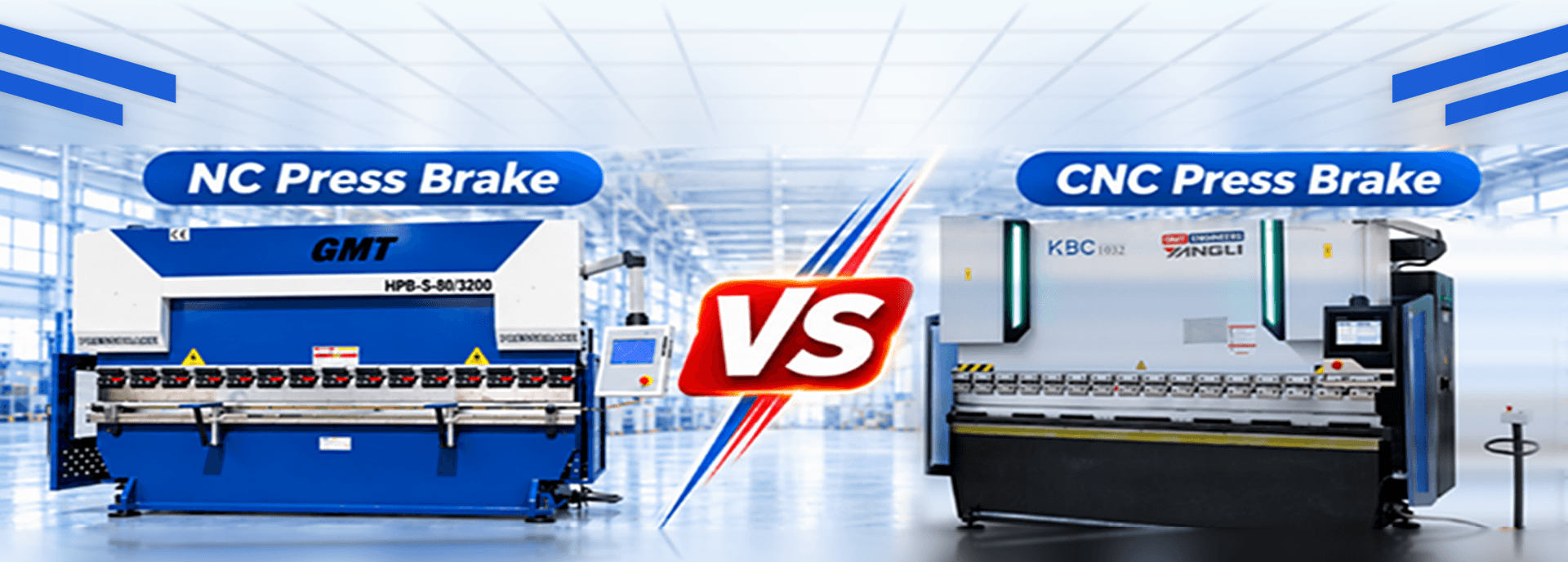
Choosing a press brake is one of the biggest equipment decisions a fabrication shop makes, and the technology is a large part of that decision. The two most common options are NC (Numerical Control) and CNC (Computer Numerical Control), and the difference between them is often misunderstood. It is not unusual for an NC machine to be described as CNC, so knowing the real difference protects your investment.
This article helps manufacturers to understand the key differences, match the right technology to their production needs, and recognize a real CNC press brake and avoid an NC machine sold as CNC.
What Is an NC Press Brake (Numerical Control)?
An NC press brake is typically an open-loop system: it sends commands to the machine but does not check the actual position. The operator enters values, typically the bend depth (ram position) and the back gauge position, and the machine repeats those settings for each stroke. Programming is done step by step at the machine, and there is little or no onboard intelligence to calculate bends for you. The ram or Y axis positioning is done by a torsion tube which is a mechanical method prone to wear and tear thereby requiring constant experienced operators to recalibrate the y axis.
Typical characteristics:
- Limited axes, often just the ram (Y) and a back gauge (X)
- No graphical display or automatic bend calculation
- Simple digital readout and keypad interface
- Limited program memory, so setup relies on operator experience
What Is a CNC Press Brake (Computer Numerical Control)?
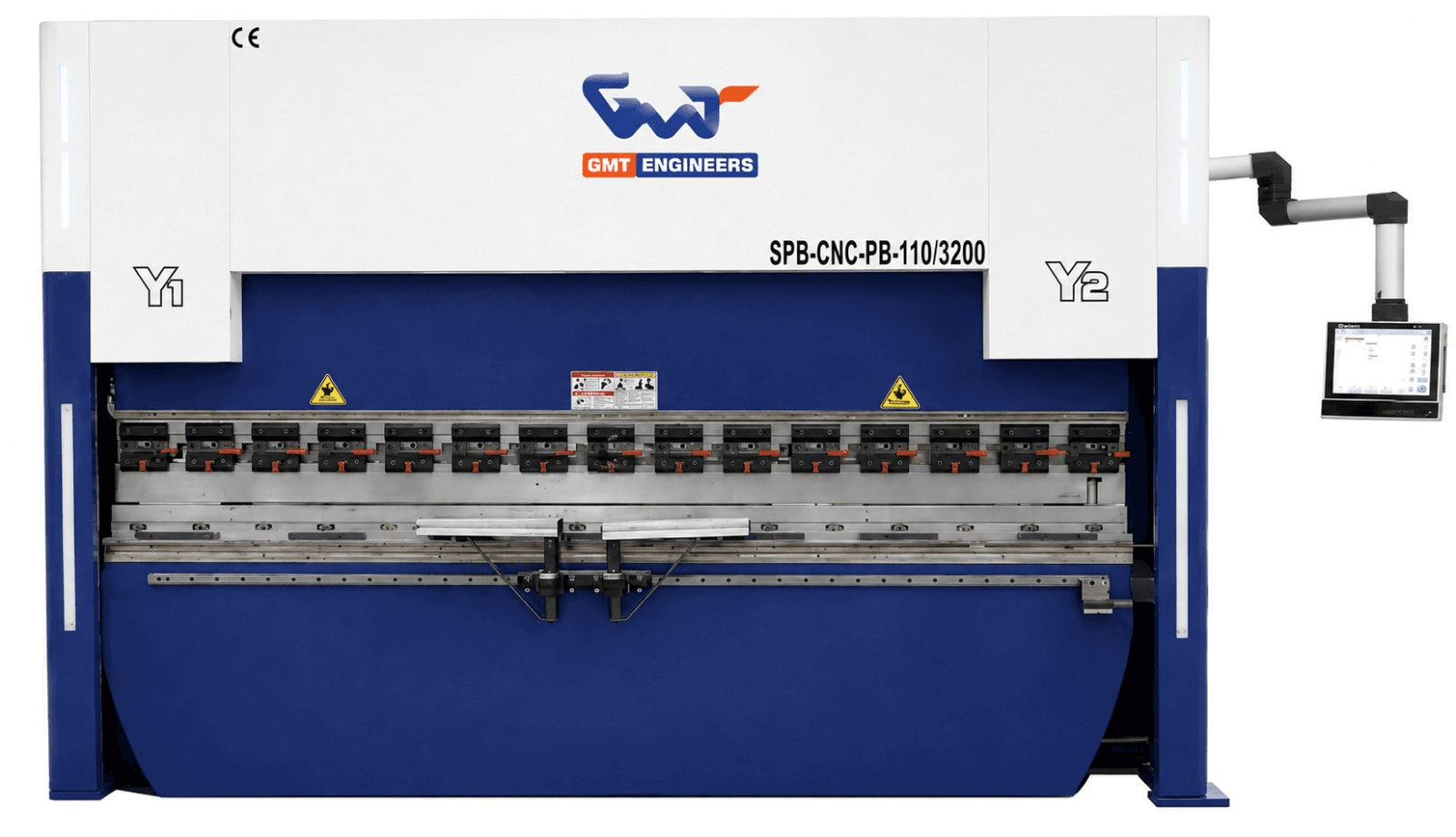
A CNC press brake is a closed-loop system: linear scales report the actual position, and the control corrects any error. It uses a computer-based controller that can calculate, store and execute complete bending programs. The operator enters the part details, such as material, thickness, bend angles and tooling, and the control works out the ram depth, back gauge positions and bend sequence.
Typical characteristics:
- Multiple controlled axes: Y1 and Y2 for the ram, X and R for the back gauge, and often Z-axes for side-to-side finger movement.
- Touchscreen or graphical interface, often with 2D or 3D part simulation
- Motorized crowning (deflection compensation)
- Closed loop control with linear scales
- Large program memory with fast recall of repeat jobs
NC vs CNC Press Brake: Key Differences at a Glance
Axis Control: NC vs CNC Press Brake
The two machines also differ in how many axes the control manages and how each axis is set. An NC press brake motorizes only its main axes and leaves the rest to be adjusted by hand. A CNC press brake controls more axes automatically and monitors the ram position with feedback.
Accuracy and Repeatability
Both control types can produce good bends, but CNC has a clear edge when parts are complex or tolerances are tight. Crowning compensates for beam deflection, and the control can adjust for material variation. With an NC machine, much of that correction depends on the operator's judgment and trial bends, which means more scrap on short runs.
Setup Time and Productivity
The biggest productivity gap shows up in setup. On an NC machine, each new job means entering values, making test bends and adjusting. On a CNC machine, you recall a saved program or build one from the drawing, and the machine positions the back gauge automatically. For shops running many different parts in small batches, this saving adds up quickly. For shops bending the same part all day, the advantage shrinks, because setup happens rarely.
Cost Considerations
NC machines have a lower upfront price and simpler maintenance, which makes them attractive for small shops and tight budgets. CNC machines cost more to buy, but they often pay back through lower scrap, faster changeovers and less dependence on a few highly skilled operators. When comparing, look at total cost of ownership rather than the sticker price alone: labor, scrap rates, training time and the value and complexity of your jobs.
Skill and Training
NC press brakes reward experienced operators who know how to read a drawing, estimate depth and correct on the fly. This takes experience to learn, so a shop depends heavily on its skilled operators. CNC controls shift part of that knowledge into the software, so newer operators can become productive sooner, though they still need to understand tooling, bend allowances and material behavior.
Which Applications Suit NC and CNC Press Brakes?
NC is a good fit when:
- Parts are simple, with one or two bends and generous tolerances
- Production is repetitive with long runs of the same part
- The machine is used for occasional or secondary work
- Experienced operators are available
- Budget is the main constraint
CNC is a good fit when:
- You want to program offline or integrate with CAD/CAM software
- You plan to add back gauge automation or angle measurement
- Bend angles must stay consistent from the first part to the last
- Fast changeover and consistent quality matter
- Job variety is high and batch sizes are small
How to Choose Between an NC and a CNC Press Brake
A few practical questions can settle most cases:
- How many different parts do you bend each week, and how often do they change?
- What tolerances do your customers require?
- What budget do you have, and how long a payback can you accept?
- How experienced are your press brake operators, and how easy is it to find more?
- Do you expect your work to become more complex over the next five years?
If your answers point to low variety, simple parts and skilled operators, an NC machine can serve you well for years. If they point to variety, precision and growth, CNC is usually the better investment. If your answers are mixed, a CNC machine with basic features may suit you best, since it adds closed-loop accuracy and faster setup without the cost of a fully equipped model.
How to Recognize a Real CNC Press Brake and Avoid an NC Machine Sold as CNC
Before you buy, check these points. A true CNC press brake should pass all of them.
- Look at the back of the machine for a torsion bar. An NC press brake normally has a torsion bar at the back, and the ram descends with the support of that bar. A true CNC press brake has no torsion bar. The ram is driven directly by the Y1 and Y2 axes, with proportional valves controlling each side.
- Ask how Y1 and Y2 are actually controlled. Some sellers add a screw and a servo motor on each side of an NC machine and label them Y1 and Y2. It looks like CNC, but the machine only follows the command. If a belt, a link rod or a screw breaks, the machine doesn’t know, because nothing reports the real position back. A true CNC controls Y1 and Y2 through proportional valves and checks them against a linear scale.
- Check for linear scales on the ram. A true CNC reads the actual ram position from linear scales on both sides. If the ram does not descend correctly, even by 0.1 mm, the scale reports it and the control corrects it. That is closed-loop feedback. Ask the supplier to show you the scales.
- Look at the controller. A CNC control has a graphical screen, usually a touchscreen that shows the part and the bend sequence. A plain digital readout with a keypad is an NC-style control. Ask for the controller brand and model.
- Ask for a live demonstration. Enter a part (material, thickness, bend angles and tooling) and watch the machine. A real CNC calculates the ram depth, back gauge positions and bend sequence, then moves the axes itself. If you have to work out each value and enter it step by step, it is an NC machine.
Why Choose GMT Press Brakes?
GMT Engineers has supplied press brakes to South Indian fabricators since 1988 with an experienced team of personnel who have served us over many years. Frames are designed and stress-tested in 3D software before a single plate of steel is cut, and stress-relieved twice to keep their shape under load.
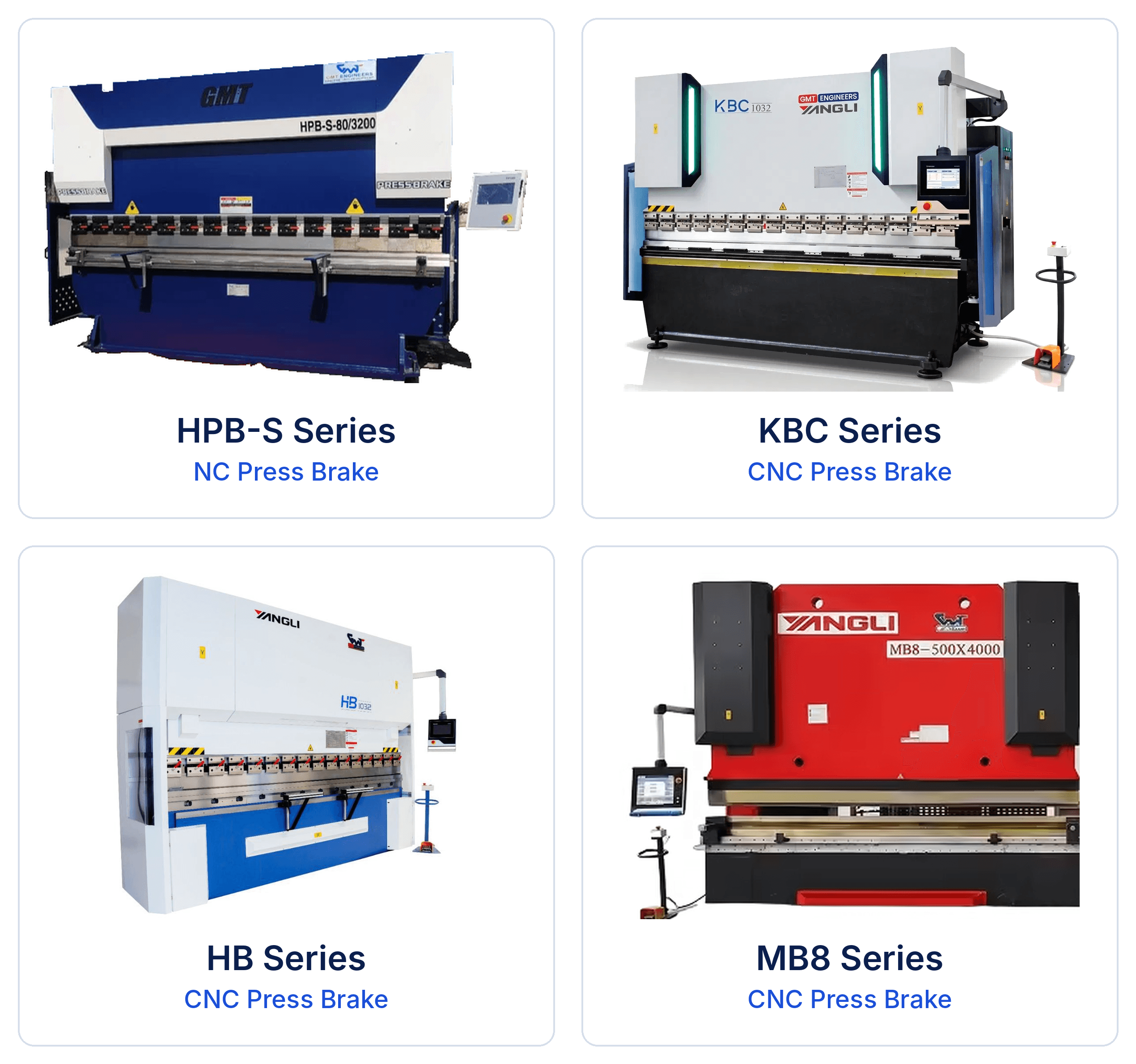
The HPB-S Series uses a mechanical rack and pinion system to keep both cylinders in step, so parallelism holds even on NC machines. Hydraulics are built for the heat and duty cycles of South Indian workshops. With support hubs and spare parts in Chennai, Coimbatore, Hyderabad, Bangalore and Kochi, help is close by. Contact GMT Engineers to find the right press brake for your shop.
Need a Quote or Service? Contact Us
Tell us your required machine model, and we’ll get back to you.
📞+91-9444678000 | ✉ webenq@gmtengineers.com
Conclusion
NC and CNC press brakes are not good and bad versions of the same machine. They are tools suited to different jobs. NC offers simplicity and a lower price, while CNC offers speed, precision and flexibility through closed-loop feedback. The choice depends on your parts, your operators and growth plans. Look at the cost, including setup time, scrap and training, not only the purchase price.
A press brake is a major investment you will live with for years, so don’t risk it on a label. A sticker doesn’t make a machine CNC. Its system does, so choose true CNC technology